

![[]](/sites/all/modules/ubercart/uc_cart/images/bullet-arrow-up.gif "Expand cart block.")
There are no products in your shopping cart.
Lumigrate's Collaborative Care Model
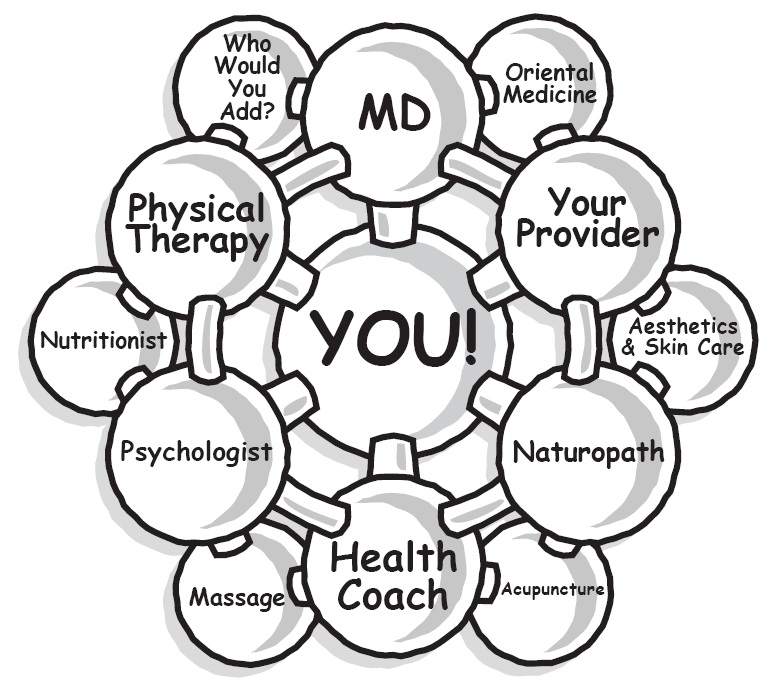 Lumigrate's content is intended to help YOU become the most empowered person in the key, central position in the center of your health care team.
Ideally, Lumigrate has offered a variety of ways to obtain no-cost information over the years, from downloadable video seminars for complete learning similar to being at a seminar, to audio podcasts and lots of readable/printable and sharable information in the readable forums, as well as 1:1 or 1:group education tutoring or "concierge" time with Mardy by phone or video call.
It was too costly with not enough supporters in the formative years to provide ongoing video and podcast content, so today, the forums tab and blog tabs are 'where it's at' for information!
Mardy Ross provides Lumigrate.com as a tool to help facilitate those who invest time and energy to become empowered, and provides cost-efficient, energy-conserving talks by phone or video calling to those who wish to have help beyond the written available at Lumigrate. Simply contact her if interested. Suggested funds in trade is $1/minute of time.
It's like we're WITH YOU in that central role of YOU! in the model! Support to the consumer is key!
The "products" tab has a history, too. Initially it routed people to Amazon to products Mardy had selected with the providers of the videos, but that was in 2008 and about a hundred things have changed since then. Today (spring 2019) there is finally A PRODUCT PRODUCER Mardy has felt so strongly about, there's an overview and link to take to their website (newly created in 2019). A percent of sales, if someone purchases after coming on the link, is registered and provided to Mardy to help support her living costs. And if our consumers support this, there will be more of this type of "vetting" and "linking".
Here's a copy of the collaborative model without anything inserted -- inspiring people to think about your 'YOU team' today or devise an 'ideal' team you'd wish you could have. Then we suggest you look in the forums to find providers that can either 'virtually' be on your team, or you hire them to consult with you OR find someone similar, inspired by what you see at Lumigrate!
We have a lot of FUN things in the forums, because we recognize how overwhelming health care can be today, and that the mind and HAPPY-ness is part of well-being for people and for our website! We set our information up so you can easily get the information to others on your team to raise their efficacy with YOU, which helps shift the "manager" position of your health from 'them' to YOU.
This might be a new concept to some, or an existing concept to others which will feel pleasantly familiar at Lumigrate for the users following here. You might have been doing this and not really realized it! Either way, we are here "Lighting your path to health and well being" and supporting YOU with these concepts as even the most educated consumer finds an increasingly challenging 'medical maze' today.
In the United States, health care has blossomed in the 200+ years our nation has existed. The Native American Indians had medical practitioners, and with the influx of people from Europe and the scientific discoveries being made in the Western world, medical treatment evolved and developed into an industry that came to rely heavily on diagnostic tests, the big pharmaceutical industry, a.k.a. 'Big Pharma', and insurance companies.
The way experiments in science developed, 'cause/effect' thinking dominated, and then treatments, drugs and otherwise, were developed to 'correct that'. Vaccines, antibiotics and surgeries greatly improved the lives of people, and they elevated those involved in the process to be up on a pedestal, literally becoming 'God-like'. That's the core of how Lumigrate is different: We champion YOU to be in the middle and all your health providers are equally as important around you!
Some might have a bigger or smaller amount of your resources (time, energy, money) and YOU are still the most capable of knowing what is going on with YOU, and where you should go next, what you should do next. Reconnecting with that 'internal guide' is also part of what we offer as information and supportive professional guides/coaches.
To be clear, conventional 'western' medicine is included as equally important to have surrounding YOU; diagnostics certainly and treatments when needed to shore a situation up while getting to the underlying reason for it, and addressing it with more natural means, or long-term when other strategies are not correcting the issue potentially. Mainstream medicine can be brilliant at surgeries, for instance, or with adaptive equipment and experts to provide prosthetics and tools.
Look at our logo, all that is coming together and creating an energy of light coming from the center, which lights the path to health and well-being!

It is important to realize that doctors, hospitals and insurance companies are businesses which work together for their common clients. Insurance companies reimburse only for practitioners and modalities they believe are appropriate to pay for: medical doctors (MDs) and osteopathic doctors (DO) and their extensions (nurse practitioners, physicians assistants) and those they prescribed referrals to (physical, occupational and speech therapy, for instance).
The insurance companies have not historically reimbursed providers for communicating with each other; as the technologies have progressed in the late 20th and early 21st centuries, this has provided a lot of frustrations and problems for the consumers and providers alike.
As other professionals lobbied and the patients and their employers who provided medical benefits requested, other services began to sometimes be reimbursed, such as chiropractic and acupuncture. Many are still not covered by insurance and are referred to as 'fee for service' or 'private pay providers'.
As increasing numbers of people are uninsured or have high copayments, it has created a demand for information and services from those providers which have developed without the reimbursement of insurance providers, which have had to therefore operate more inexpensively. These are typically referred to as CAM (complementary and alternative medicine). It's a huge transitional time in medicine and there is an undeniably 'health care crisis' in the United States and beyond.
Both the medical providers and the insurance companies have operated under what is called "Western medicine" or "conventional medicine", abbreviated ConMed and stems from the 'allopathic medical model'. The word 'pathogen' became the center of scientific thinking with medicine in the modern medical era, and much advancement was made with the advent of understanding bacteria and viruses and other causes of disease, and our medical system grew to be based on this 'model' of thinking and treating and billing.
Due to the overwhelming advances, it has become a very big task to have codes and systems for charging for services. As more and more people were appropriate for treatments with modern medicine and more medications were available, health care costs went up, and as most of us are aware, medical professionals generally had to spend less time with each patient. Sometimes specific treatments were no longer covered. It has been a constantly changing business, and it continues to change every day.
By now, most everyone is aware and likely concerned with the state of the health care system due to these changes. Providers often feel frenzied, patients sometimes feel they have fallen in a crack, and an incredible amount of resources go into the billing and revenue collections piece of the medical businesses, which eventually leads to the providers having to see more patients in order to generate enough revenue to pay for everything... the proverbial 'vicious cycle'.
But when medical professionals are not linked into billing health insurance companies for the services they provide to patients, it changes how the health care providers and patients can interact. Since insurance companies do not reimburse providers for their time charting or communicating about patients to other providers, they are not inclined to spend more time than absolutely necessary on communication. The 'Collaborative Care Model' is another model which has been in existence and has been proven to increase financial efficiency and patient satisfaction in many organizations which have utilized it.
Chris Young, Ph.D., a psychologist and co-owner of Behavioral Health and Wellness with Cheryl Young, his wife (who is a marriage and family therapist and child advocate/expert), has studied medical models and experienced both the collaborative care model during training in the U.S. military and the western allopathic model as an owner of a large behavioral health practice in Grand Junction. Dr. Young presented "Health Management: Paradigms for Health Care" during the first year of an Integrative Medicine Center he and Mardy and others were part of for it's formative year in 2008/9. You can view a segment by clicking here and we hope you take the time to download and spend an hour watching this very informative and thought-provoking video if this has piqued your interest in theories related to changing our systems in the United States (and beyond).
There are many hours of free video (videos tab IF it's still working, this was created in 2008 so is like an old work horse at this point), podcasts (currently in the Forums at the very top of the list, hosted at the website of the podcast provider, Adam Cochran of Talking Digital, with the understanding there would be long term continuity of podcasts housed there when created circa 2010), and hundreds of helpful topics in Forums related to maintaining or achieving wellness through 'integrative medicine' (bringing many provider realms together and seeking the most natural form of interventions first) and looking at the 'functional' reasons for an illness and correcting them.
Thank you for reading about Lumigrate's You And as my 'sign off' says when I write in the forums ~~ "Live and Learn... Learn and Live Better!!" ~~ Mardy

 print
print e-mail
